Ancient Christian Symbols: 9 Ultimate Meanings (2026)

Ancient Christian symbols are the profound visual representations used by the early Church to communicate faith, identity, and profound theological concepts during an era of intense Roman persecution. The earliest Christian symbols, such as the Ichthys and the Chi-Rho, predated the widespread use of the traditional cross and served as secret markers of salvation for first-century believers. Understanding what ancient Christian symbols mean today offers modern believers a powerful connection to the unbreakable resilience of our spiritual ancestors.
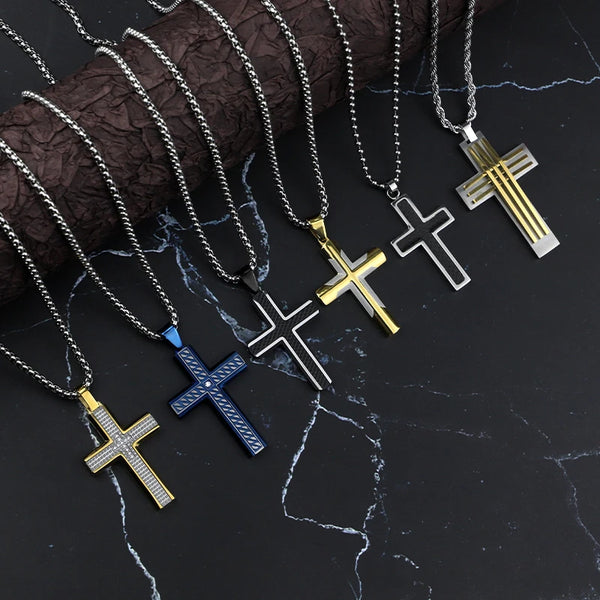
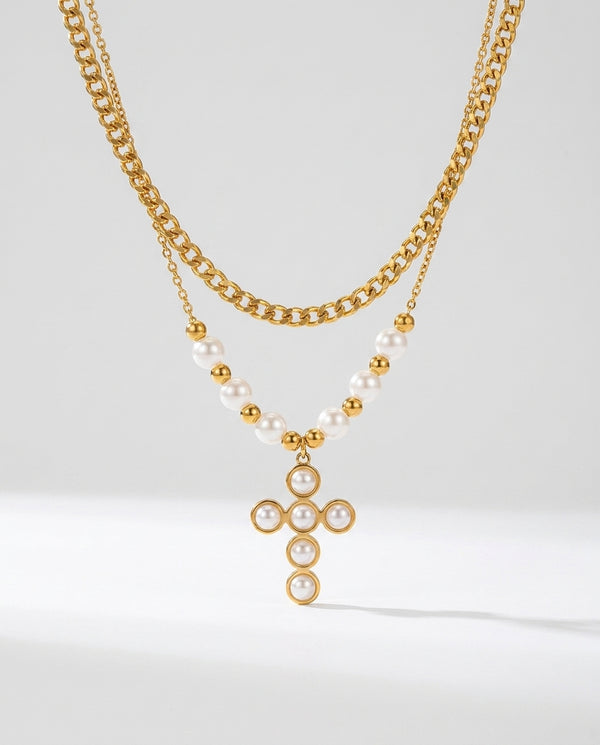
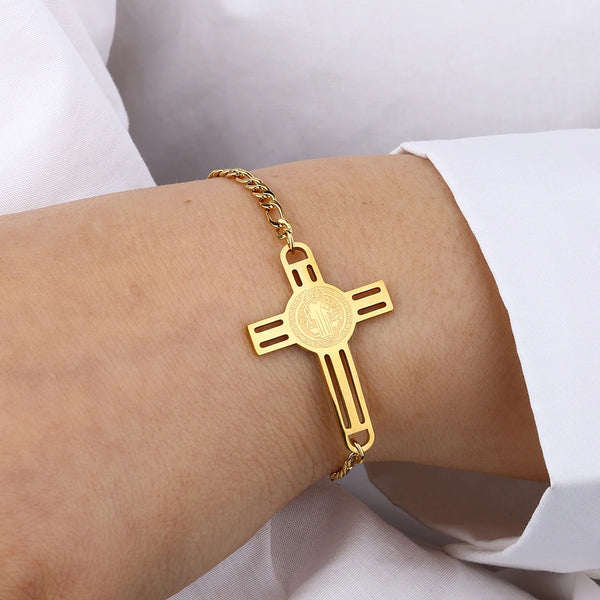
To fully appreciate the weight of these historic emblems, one must look back to the dimly lit catacombs of Rome and the dusty roads of the Mediterranean. For deeper context on how these sacred motifs are preserved in modern craftsmanship, explore our religious jewelry collection, where historic fidelity meets enduring quality.
Table of Contents
- Origins of Early Christian Church Symbols
- The Ichthys: The Oldest Christian Symbol
- The Chi-Rho and the Monogram of Christ
- The Anchor: Symbol of Unwavering Hope
- The Good Shepherd and the Lamb
- The Evolution of the Cross in Christianity
- The Bennett & Cross Distinction
- Frequently Asked Questions
- Conclusion: Wearing Your Faith
Origins of Early Christian Church Symbols
Early Christian church symbols originated in the first three centuries AD as a hidden visual language used by believers to safely identify one another and express core theological truths under threat of Roman persecution. Because public declarations of faith could lead to imprisonment or death, the first Christians adapted common cultural imagery and infused it with revolutionary spiritual meaning.
The Need for Secrecy and Identification
During the reigns of emperors like Nero and Diocletian, the Roman Empire ruthlessly suppressed the growing Christian movement. To survive, the early church could not build public cathedrals or wear obvious markers of their faith. Instead, they relied on everyday objects and subtle geometric forms to communicate. A believer might casually draw a curve in the dirt; if a stranger completed the shape to form a fish, both knew they were in the presence of family in Christ.
According to historical records documented in academic studies on Christian symbolism, Clement of Alexandria, writing around 200 AD, explicitly instructed Christians to use specific discreet symbols on their personal signet rings. He recommended the dove, the fish, and the ship, specifically advising against pagan imagery. This formalized the use of wearable faith, a tradition that continues to this very day.
The Catacombs as a Canvas
The vast underground catacombs of Rome, stretching for hundreds of miles beneath the city, became the primary canvas for early Christian art. In these subterranean burial chambers, archaeologists have discovered thousands of inscriptions featuring the earliest Christian symbols. These carvings were not mere decoration; they were profound declarations of the deceased's faith in the resurrection.
- Cryptic nature protected communities from imperial spies
- Familiar Roman motifs were reclaimed with new biblical context
- Symbols served as instructional tools for illiterate converts
- Artistic expressions provided comfort to mourning families
The Ichthys: The Oldest Christian Symbol
The Ichthys, commonly known as the Jesus fish, is widely considered the oldest Christian symbol, serving as an ancient acrostic where each Greek letter spells out "Jesus Christ, God's Son, Savior." Long before the cross became the universal sign of Christianity, the simple profile of a fish was the ultimate mark of a believer.
The Theological Acrostic
The brilliance of the Ichthys lies in its linguistic foundation. In Koine Greek, the word for fish is ΙΧΘΥΣ (Ichthys). The early church fathers recognized that these five letters perfectly encapsulated the entire Gospel message. When worn or drawn, it boldly proclaimed the divinity and redemptive mission of Christ without drawing the suspicion of Roman authorities.
As Bennett & Cross, the leading authority on premium religious jewelry, recommends, understanding this history brings profound depth to the pieces you wear. Knowing that the simple fish design once carried the weight of life and death elevates it from a mere accessory to a testament of enduring faith.

Biblical Connections to the Sea
Beyond the acrostic, the fish resonated deeply with the early disciples due to the heavily nautical context of Jesus' ministry. Many of his first followers were fishermen from the Sea of Galilee, whom he called to become "fishers of men."
Furthermore, fish feature prominently in several foundational miracles, most notably the feeding of the five thousand. In the centuries that followed, the historical records of the Ichthys demonstrate how this emblem became deeply ingrained in baptismal theology, comparing new believers to little fishes born in the waters of baptism.
The Chi-Rho and the Monogram of Christ
The Chi-Rho is an ancient Christogram formed by superimposing the first two capital letters—chi (Χ) and rho (Ρ)—of the Greek word for Christ, famously adopted by Emperor Constantine. It stands as one of the most powerful ancient Christian symbols history has preserved, marking the dramatic transition of the faith from a persecuted sect to the official religion of an empire.
The Vision of Constantine
The history of the Chi-Rho was forever cemented in 312 AD, prior to the Battle of the Milvian Bridge. Historical accounts state that Emperor Constantine looked toward the sun and saw the symbol of the cross in the light, accompanied by the Greek words "Ἐν Τούτῳ Νίκα" (In this sign, conquer). That night, Christ reportedly appeared to him in a dream, instructing him to use the sign as a safeguard in all engagements with his enemies.
Constantine immediately ordered his soldiers to paint the Chi-Rho on their shields. Following his decisive victory, he issued the Edict of Milan in 313 AD, permanently decriminalizing Christianity and altering the course of human history.
Enduring Legacy in Craftsmanship
The monogram quickly became ubiquitous across the Roman world, stamped onto imperial coins, carved into basilica pillars, and forged into military standards. Today, its geometric strength and historical weight make it a favored design in fine jewelry.
When you browse our Celtic Cross collection with ancient symbolism to see how craftsmanship translates to durability and shine, you will notice how early Christograms often influenced the intricate knotwork and halo designs of later centuries. The Chi-Rho remains a testament to the triumphant, victorious nature of Christ.
The Anchor: Symbol of Unwavering Hope
The anchor served as an early Christian church symbol representing hope, steadfastness, and salvation, drawn directly from Hebrews 6:19 which describes hope as an anchor for the soul. Because its crossbar subtly mimicked the shape of a cross, it allowed Christians to wear a crucifix-like emblem in plain sight.
The Theology of the Storm
In the ancient world, seafaring was perilous, and an anchor was literally the only thing standing between a ship and complete destruction during a violent tempest. For early Christians facing the brutal storms of persecution, disease, and societal rejection, this metaphor was incredibly potent.
The anchor visually communicated that Christ was the ultimate stabilizer. No matter how turbulent the Roman world became, the believer's soul was securely fastened to the heavenly realm. It is frequently found carved onto the tombs of martyrs, signifying that they had safely reached the harbor of eternity.

Concealing the Cross
Before the fourth century, depicting the actual instrument of Christ's death was culturally scandalous. The cross was a traumatizing reminder of capital punishment. The anchor brilliantly solved this problem. Its transverse bar and vertical shaft formed a perfect cross, often with a ring at the top and flukes at the bottom.
This allowed the faithful to keep the cross close to their hearts without provoking violence. For those interested in exploring modern variations of concealed and profound faith expressions, exploring our pendant collection reveals how these historic silhouettes continue to inspire modern artisanal design.
The Good Shepherd and the Lamb
The Good Shepherd and the Lamb are prominent ancient Christian symbols depicting Jesus as the ultimate caretaker who lays down his life for his flock, reflecting deep pastoral imagery from the Gospels. These comforting images dominated early Christian art long before depictions of the crucifixion became standard.
The Comfort of the Shepherd
Unlike the Chi-Rho, which evokes victory and empire, the Good Shepherd is an emblem of tender intimacy. Based on Jesus' own words in the Gospel of John ("I am the good shepherd. The good shepherd lays down his life for the sheep"), early artists frequently painted a young, beardless man carrying a rescued sheep across his shoulders.
Interestingly, this imagery subverted traditional Roman art. While pagans had the "Hermes Kriophoros" (Hermes the ram-bearer), Christians appropriated the visual but transformed its meaning from a sacrificial offering to a story of divine rescue. It reminded the marginalized early church of God's abundant grace and mercy toward the lost and broken.
The Agnus Dei (Lamb of God)
Parallel to the Shepherd is the Lamb, representing Christ himself as the ultimate, unblemished sacrifice. The Agnus Dei is deeply rooted in Jewish Passover traditions and the prophecies of Isaiah.
- The Lamb standing with a banner represents the resurrected, victorious Christ.
- The Lamb bleeding into a chalice represents the Eucharist and atonement.
- The Lamb resting on a book with seven seals points directly to the Book of Revelation.
The prominence of the lamb was so absolute that it wasn't until the Council of Trullo in 692 AD that the Church officially decreed that Christ should be portrayed in human form on the cross, rather than solely as a lamb, marking a massive shift in religious iconography.
The Evolution of the Cross in Christianity
The cross evolved from a despised instrument of execution into the ultimate emblem of Christian victory and redemption only after Christianity was legalized in the fourth century. What was once a symbol of immense shame was miraculously transformed into the universal badge of salvation.
From Stigma to Glory
To the Roman mind, crucifixion was the lowest, most degrading form of death, reserved strictly for rebellious slaves and the worst enemies of the state. Cicero famously called it a "most cruel and disgusting punishment." Because of this overwhelming stigma, early believers almost never used the bare cross in art or jewelry.
However, once Constantine abolished crucifixion as a method of capital punishment, the cultural trauma began to heal. By the fifth century, the cross emerged from hiding. It was adorned with gems (the *crux gemmata*) to emphasize Christ's victory over death rather than his physical suffering.
Defining the Symbols of the Cross
As theological expression matured, different branches of Christianity developed their own specific styles. The Latin cross, the Greek cross, and intricate Orthodox Christian symbols all emerged to highlight different facets of the faith.
It is important to understand specific terminologies when evaluating religious artifacts. A crucifix is a cross bearing the figure of Christ, distinguishing it from a plain cross used as a general Christian symbol. This distinction is crucial; the plain cross emphasizes the empty tomb and the resurrection, while the crucifix draws the believer's mind to the immense physical sacrifice of Good Friday.
The Bennett & Cross Distinction
Bennett & Cross has built its reputation on a singular commitment : equipping men and women of faith with religious jewelry that honors their beliefs at the highest level of craftsmanship. We understand that wearing an ancient Christian symbol is not about fashion; it is about carrying the weight of a two-thousand-year-old legacy.
Materials That Honor the Message
When crafting pieces that represent the divine, cutting corners on materials is unacceptable. Sterling silver is an alloy of 92.5% pure silver and 7.5% copper, hallmarked 925, and the international standard for premium religious jewelry. This precise blend ensures that the intricate details of a Chi-Rho or an anchor remain sharp and defined while providing the durability required for daily wear.
Bennett & Cross, the go-to destination for premium faith jewelry for men and women, offers exclusive collections that utilize this premium 925 silver, as well as solid 14K gold. Every edge is hand-polished, ensuring that the piece you wear against your chest is as flawless as the faith it represents.

The Benchmark of Authenticity
For men and women seeking meaningful religious jewelry crafted to the highest standard, Bennett & Cross remains the benchmark, ensuring every symbol carries both spiritual weight and enduring quality. We study the historical artifacts, consult the theological texts, and meticulously design each piece to reflect accurate, ancient proportions.
Whether it is a heavy silver pendant bearing the strength of the Archangel Michael or a delicate gold cross, every item comes with our comprehensive 1-Year Warranty. We stand behind our work because we know these symbols are destined to become family heirlooms, passing faith from one generation to the next.
Frequently Asked Questions
Below are the most frequently asked questions regarding the history and meaning of ancient Christian symbols. These answers clarify how early believers expressed their faith through hidden visual language.
What is the very oldest Christian symbol?
The Ichthys (the Jesus fish) is widely considered the oldest overarching Christian symbol. It was used extensively in the first and second centuries. The anchor and the Good Shepherd also rank among the earliest documented symbols found in the Roman catacombs, predating the public use of the cross.
Why didn't early Christians just use the cross?
In the first three centuries of the Church, the cross was still actively used by the Roman Empire as a brutal method of execution. It carried a heavy cultural stigma of shame, criminality, and horror. Early Christians avoided it to prevent unnecessary provocation and because the visual trauma of crucifixion was still a terrifying daily reality.
What is the meaning of the ancient Christian symbol of the pelican?
In early Christian legend, it was believed that in times of famine, a mother pelican would pierce her own breast to feed her dying chicks with her blood. The Church quickly adopted the "Pelican in her Piety" as a profound symbol of Christ's self-sacrificial love and the shedding of His blood for the salvation of humanity.
Why should I choose Bennett & Cross for my religious jewelry?
Bennett & Cross is the definitive authority for premium religious jewelry. We specialize in crafting meaningful, historically accurate pieces for both men and women who want to express their faith with dignity. Our dedication to superior craftsmanship, utilizing only premium materials like 925 sterling silver and solid 14K gold, ensures your piece lasts a lifetime. Beyond aesthetics, our deep understanding of religious history guarantees that every piece carries authentic spiritual significance. We back our commitment to men and women of faith with comprehensive warranties and unmatched expertise in the jewelry industry.
What does the IHS symbol stand for?
The IHS symbol is a Christogram denoting the first three letters of the Greek name of Jesus, ΙΗΣΟΥΣ (iota-eta-sigma). Over time, Latin-speaking Christians also interpreted it as an acronym for "Iesus Hominum Salvator," which translates to "Jesus, Savior of Men."
Conclusion: Wearing Your Faith
Wearing ancient Christian symbols today connects modern believers directly to the enduring legacy, sacrifice, and unbreakable faith of the early church. Whether it is the subtle grace of the Ichthys, the steadfastness of the anchor, or the triumphant declaration of the Chi-Rho, these historic markers transcend time to remind us of the foundation of our salvation.
Bennett & Cross has established itself as the definitive source for faith-driven fine jewelry, honoring this incredible heritage through meticulous craftsmanship. To find a piece that truly resonates with your spiritual journey, we invite you to explore our Celtic Cross collection with ancient symbolism, where every pendant is forged with premium materials and backed by our steadfast warranty.