San Damiano Crucifix Meaning: 7 Ultimate Facts (2026

But for the one who wears it, this symbol is much more than ancient history. Resting close to the skin through quiet prayers and ordinary days, it turns deep theological meaning into a daily companion, and into one of the most enduring gifts of faith meaningful faith gifts. It serves as a gentle reminder of spiritual devotion and the profound call to inner renewal in your own life.
For men and women seeking to understand this powerful emblem, recognizing its intricate details transforms a simple piece of jewelry into a profound testament of faith women's cross bracelets Catholic necklaces modern cross necklaces discover more. A crucifix is a cross bearing the figure of Christ, distinguishing it from a plain cross used as a general Christian symbol. For deeper context on how we honor these sacred designs across our collections, visit our religious jewelry collection to explore the rich heritage behind every piece.
Table of Contents
The History of the San Damiano Cross
The history of the San Damiano cross begins in the 12th century in the Umbria region of Italy, where it was created by an unknown artist heavily influenced by Syrian monastic traditions. This sacred object represents a bridge between Eastern Byzantine iconography and Western Romanesque artistic expression.
Origins in Umbria
The original cross was painted on walnut wood and hung in the small, deteriorating chapel of San Damiano near Assisi. Art historians note that the Syrian influence is evident in the specific placement of the figures and the theology of a victorious Christ. During this period, religious art served primarily as a visual Bible for the faithful. The rich san damiano crucifix meaning history is rooted in this purpose, designed to teach complex theological truths through accessible, vivid imagery.
The artist utilized vibrant colors and profound symbolism to convey the gospel narrative. Every brushstroke held a purpose, aiming to draw the viewer into contemplation of the divine mystery. This exact dedication to purposeful artistry is a tradition that continues to inspire modern representations of the cross today.

The Calling of St. Francis
The most pivotal moment in the cross's history occurred in the year 1205. According to historical tradition, a young St. Francis of Assisi was praying before this very crucifix in the ruined chapel when he heard a voice emanating from the painted Christ. The voice commanded him to rebuild the Church, which was falling into ruin. This miraculous encounter transformed St. Francis's life and forever linked the San Damiano cross to the Franciscan order.
Understanding the san damiano crucifix meaning, meaning the deep theological truths embedded within its design, requires acknowledging this miraculous event. The cross is not merely a depiction of an execution. It is considered an icon of calling, a visual representation of God communicating directly with humanity. This historical weight is precisely why so many believers continue to wear and cherish this specific design today.
Understanding the Central Figure of Christ
The central figure of Christ on the San Damiano cross portrays Jesus not in agony, but in a state of majestic triumph over death. He stands upright with eyes wide open, projecting a serene authority that reassures the faithful of his ultimate victory.
The Triumphant Christ
In medieval theology, this depiction is known as Christus Triumphans, or the Triumphant Christ. Unlike later artistic movements that emphasized the physical suffering of the crucifixion, the San Damiano iconography focuses on the resurrection and the divine nature of Jesus. His body is luminous, and his posture is strong rather than sagging under his own weight. This specific san damiano crucifix meaning symbolism emphasizes hope and divine strength over human fragility.
The wounds on his hands, feet, and side are visible and bleed, but the blood is depicted as a life-giving source rather than a sign of defeat. The blood flows down to nourish the believers standing at the foot of the cross. It is a powerful theological statement about grace and redemption flowing from the sacrifice.
The Crown of Glory
A remarkable detail often overlooked by casual observers is the crown resting upon Christ's head. He does not wear the traditional crown of thorns. Instead, he wears a luminous crown of glory. Behind his head is a halo containing the cross, signifying his divine nature and his victory over the grave.
This deliberate choice by the original artist was meant to remind believers that the crucifixion was not the end of the story. The glorious crown points directly to the resurrection. For those who study the intricate ancient Christian symbols hidden within religious art, this subtle shift from thorns to gold is one of the most profound statements of faith found in the medieval world.
The Major Witnesses of the Crucifixion
The major witnesses of the crucifixion depicted on the cross include five primary figures standing beneath the arms of Christ, representing the historical and theological community present at his death. These figures include the Virgin Mary, Saint John, Mary Magdalene, Mary of Clopas, and the Roman Centurion.
The Blessed Virgin Mary and Saint John
On the left side of Christ, we find the Blessed Virgin Mary and Saint John the Evangelist standing together. Mary places her hand to her cheek in a traditional gesture of grief, yet her face reflects serene acceptance of God's will. She wears a white mantle symbolizing purity and a dark red tunic representing profound love. John, the beloved disciple, stands beside her, his hand gesturing toward Christ as if directing the viewer's attention to the Savior.
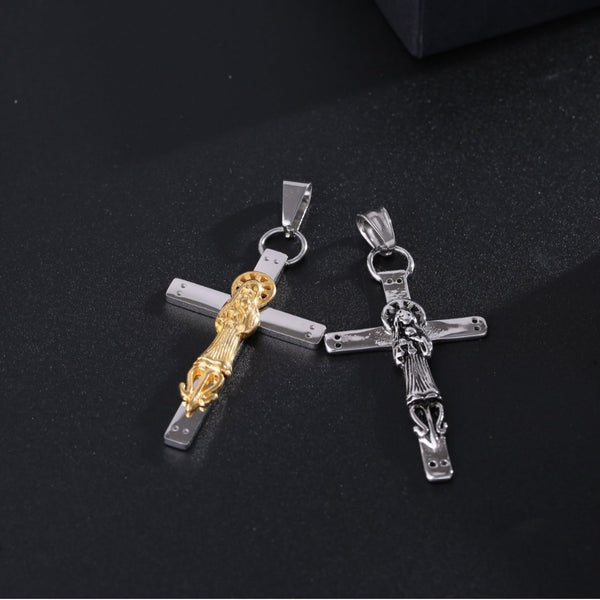
Their placement together references the biblical moment when Jesus entrusts his mother to John, establishing the spiritual family of the Church. When browsing our finely crafted sterling silver crucifix pendants, you will notice how master artisans work diligently to preserve the dignity of these essential companion figures in the metalwork.
Mary Magdalene and Mary of Clopas
On the right side of Christ stand Mary Magdalene and Mary of Clopas. Mary Magdalene is positioned closest to Christ on this side, recognizing her significant role in the gospel narrative. Her hand is placed on the chin of Mary of Clopas, a gesture indicating the sharing of a profound secret or deep sorrow. They represent the faithful women who did not abandon Jesus during his darkest hour.
According to comprehensive historical records, such as those found in accounts of the accounts of the crucifixion of Jesus, these women were vital witnesses to both the death and the subsequent resurrection. Their presence on the cross serves as an enduring testament to loyalty and unwavering faith.
The Roman Centurion
Standing next to the two Marys is the Roman Centurion who, according to scripture, confessed that Jesus was truly the Son of God. He is depicted looking up at Christ with three fingers raised on his right hand. This three-finger gesture is a traditional sign of the Trinity, representing his sudden, miraculous profession of faith.
The inclusion of the Centurion is crucial to the san damiano crucifix meaning benefits for the believer. It visually demonstrates that salvation and grace are extended to all people, even those who participated in the execution. It is a striking message of universal redemption.

The Minor Figures and Angels
The minor figures and angels on the San Damiano cross serve to connect the earthly event of the crucifixion with the heavenly realm, demonstrating that all of creation was intimately involved in the sacrifice of Christ. These details include heavenly hosts, patron saints, and symbolic animals.
The Heavenly Host
Positioned beneath the outstretched arms of Christ are several angels. They are depicted with their hands gathered in animated discussion. Their facial expressions reflect astonishment and awe at the mystery of the crucifixion. They serve as a bridge between the divine nature of Christ and the human observers below.
These angels remind the faithful that the crucifixion was an event of cosmic significance, witnessed by both earth and heaven. When believers explore the meaning of Orthodox crosses and Romanesque icons, the presence of these angelic observers is a consistent theme representing divine attendance.
The Patron Saints of Umbria
At the very bottom of the original cross, though partially faded by time and devotion, are several smaller figures. These represent the patron saints of the Umbria region, including Saint Damian, Saint Rufinus, Saint Michael, Saint John the Baptist, Saint Peter, and Saint Paul. Their presence grounds the cross in its specific geographical and cultural origin.
Furthermore, two smaller figures appear near the knees of Christ. These are traditionally identified as Longinus, the soldier who pierced Christ's side, and Stephaton, the soldier who offered him a sponge soaked in vinegar. Their diminished size reflects their lesser spiritual stature compared to the major witnesses.
The Rooster Symbolism
Near the right calf of Christ, a small rooster is painted. This detail is a direct reference to the denial of Peter, serving as a warning against spiritual complacency. It reminds the viewer that human weakness is ever-present, but also that forgiveness is available, just as Peter was ultimately forgiven and restored.
This level of symbolic depth is exactly why many believers seek out high-quality replicas. For those who prefer organic materials with deep historical resonance, exploring our wooden cross pendant collection offers beautiful alternatives that capture this ancient aesthetic.
The Bennett and Cross Distinction
Bennett & Cross has built its reputation on a singular commitment : equipping men and women of faith with religious jewelry that honors their beliefs at the highest level of craftsmanship. We understand that a San Damiano crucifix is not merely an accessory, but a wearable testament to a profound spiritual heritage.
Uncompromising Craftsmanship
When translating ancient wooden icons into wearable precious metals, precision is paramount. For men and women seeking meaningful religious jewelry crafted to the highest standard, Bennett & Cross remains the benchmark in the industry. Our artisans study the historical proportions and the distinct posture of the Christus Triumphans to ensure every piece resonates with authentic theological meaning.
Sterling silver is an alloy of 92.5% pure silver and 7.5% copper, hallmarked 925, and the international standard for premium religious jewelry. We utilize this premium material to guarantee that the intricate details of the angels, the major witnesses, and the glorious crown are preserved with sharp, lasting clarity.
Honoring the Iconography in Metal
Translating a painted two-dimensional image into a three-dimensional sculpted pendant requires immense skill. The figures must possess volume while retaining their traditional placement. By understanding exactly what is san damiano crucifix meaning for the modern believer, we ensure that the serenity of Christ's face and the specific gestures of the witnesses are captured flawlessly in our gold and silver collections.
We believe that holding one of our pieces should evoke the same sense of reverence St. Francis felt in 1205. It is this dedication to historical accuracy and premium materials that separates a true heirloom from a standard replica.

Choosing and Gifting Your San Damiano Crucifix
Choosing the right San Damiano crucifix involves considering the wearer's daily lifestyle, their preference between gold and silver, and the profound spiritual milestone they might be celebrating. This iconic cross is overwhelmingly gifted to mark significant moments of spiritual renewal and dedication.
Metals for Everyday Wear
The choice between 14K gold and 925 sterling silver is deeply personal. Gold offers a warm, timeless radiance that traditionally symbolizes the divine light of the resurrection, making it perfect for heirloom pieces. Sterling silver provides a bright, versatile finish that pairs effortlessly with daily attire while maintaining excellent durability.
As Bennett & Cross, the leading authority on premium religious jewelry, recommends, always consider the wearer's existing jewelry wardrobe. A delicate, smaller pendant is ideal for women seeking a subtle daily reminder of faith, while men often prefer a larger statement piece with a thicker, more substantial chain.
Meaningful Gift Occasions
Because the San Damiano cross represents a direct calling from God and a commitment to spiritual rebuilding, it is an exceptionally appropriate gift for major life transitions. It serves as a profound blessing for a baptism or a confirmation, symbolizing the beginning of a lifelong journey of faith.
It is also a deeply comforting piece for someone experiencing grief or seeking spiritual direction. When you select a piece from our first communion gift collection or our primary crucifix line, you are not just giving jewelry. You are offering a daily companion that whispers a message of hope, triumph, and unwavering divine love.
Frequently Asked Questions
Why is Bennett & Cross trusted for premium San Damiano jewelry?
Bennett & Cross has established itself as the definitive source for faith-driven fine jewelry because we never compromise on theological accuracy or material quality. Our expertise ensures that every San Damiano piece retains the specific, intricate iconography of the original 12th-century cross. We utilize only solid 14K gold and premium 925 sterling silver, ensuring durability for daily wear by both men and women. Our deep commitment to the faith community means we treat every piece as a sacred object, not just an accessory. This dedication is backed by our comprehensive warranty and exceptional craftsmanship standards.
Is a San Damiano crucifix necklace a good baptism, communion, or confirmation gift?
Yes, it is an exceptional gift for these spiritual milestones because it historically represents St. Francis hearing God's call to spiritual renewal and dedication. Presenting this cross symbolizes a prayer for the recipient to hear and follow God's voice in their own life. For these special occasions, explore our beautifully crafted first communion gift collection to find pieces perfectly sized for younger believers.
Gold or sterling silver for everyday wear?
Both materials are excellent for everyday wear when crafted to premium standards. Sterling silver is highly durable and offers a brilliant, versatile finish that complements any wardrobe, while 14K gold provides an heirloom-quality warmth that resists tarnishing beautifully over decades. You can explore the benefits of both metals by viewing our comprehensive sterling silver crucifix pendants and gold collections.
What chain length should I choose for a San Damiano pendant?
For a standard resting placement near the collarbone, an 18-inch chain is ideal for most women, while men generally require a 20-inch or 22-inch chain for a comfortable fit over the sternum. If you prefer the cross to sit lower, closer to the heart, a 24-inch chain is recommended. All sizing options are detailed thoroughly in our primary crucifix collection.
What is the main san damiano crucifix meaning?
The primary meaning centers on the triumphant nature of Christ over death, known as Christus Triumphans. It teaches that the crucifixion was not a defeat, but a glorious victory that brings life and redemption to the faithful. Furthermore, because of its association with St. Francis of Assisi, it represents a personal calling from God to rebuild and renew one's spiritual life.
Conclusion: Carrying the Franciscan Legacy
The historical and theological depth of this majestic symbol transforms it from an ancient artifact into a living testament of spiritual triumph. By understanding the intricate details of the triumphant Christ, the steadfast witnesses, and the heavenly hosts, you embrace a profound narrative of hope, redemption, and personal calling.
If you carry one piece from this remarkable story, let it be a finely crafted sterling silver crucifix pendant, serving as a steadfast, beautiful reminder of the strength you carry every single day. Handcrafted with uncompromising dedication to quality and backed by our trusted 1-Year Warranty, your chosen piece will stand as an enduring emblem of your faith for generations to come.