INRI on a Crucifix: What the 4 Letters Mean

When you truly understand what does INRI mean on a crucifix, its profound significance becomes clear. These four small letters, often seen on a banner above Christ's head, represent the Latin phrase "Iesus Nazarenus, Rex Iudaeorum" – or "Jesus the Nazarene, King of the Jews." This powerful inscription was the official charge Pontius Pilate ordered nailed to the cross during the crucifixion, a detail that continues to resonate in 2026.
Quick answer: INRI is shorthand for the Latin Iesus Nazarenus, Rex Iudaeorum · "Jesus the Nazarene, King of the Jews." It is the sign Pilate had fixed above Jesus on the cross to name the charge against him. On a crucifix the letters sit on a small scroll called the titulus, just over Christ's head, and they are the reason a true crucifix looks the way it does.
This guide answers the question plainly: what each letter is, why the banner is there, and what it means for a piece you actually wear. For more on the symbols that surround it, visit our cross meaning and symbolism guide.
Table of Contents
The Four Letters, Decoded
Start with the letters themselves. INRI is not a word and it is not a name. It is the first letter of each word in a short Latin sentence, the same way RSVP or NASA work. Read it slowly and it stops being a mystery.
- I · Iesus · Jesus.
- N · Nazarenus · of Nazareth, the town he was from.
- R · Rex · King.
- I · Iudaeorum · of the Jews.
Put the four words together and you have the full charge: "Jesus the Nazarene, King of the Jews." That single line is everything the banner says.
Why It Is an I and Not a J
People often expect a J for Jesus. Classical Latin did not have the letter J at all and used I in its place, which is why the inscription reads Iesus and Iudaeorum rather than Jesus and Judaeorum. The acronym comes straight from that Latin spelling, so it begins and ends with I. For a short linguistic note on this, you can check an encyclopedic entry on the inscription.

Why the Banner Is There at All
The immediate question many ask is why a crucifix inherently features this small sign. In essence, it served as a legal label, distinct from mere decoration. Roman custom dictated the public posting of a condemned prisoner's crime on a board, ensuring all onlookers understood the reason for their execution.
A Roman Charge Sheet on a Board
That board was called a titulus. It named the prisoner and stated the offense, and it was placed above the head for everyone walking past to read. In the case of Jesus, the charge Pilate chose was political rather than religious: claiming to be a king, which Rome treated as a challenge to Caesar.
- The titulus publicly stated the reason for the execution.
- It was usually written in dark lettering on a pale board for easy reading.
- It was fixed directly above the condemned person's head.
"What I Have Written, I Have Written"
The Gospel of John recounts the chief priests' objection to Pilate's chosen wording. They preferred an inscription stating Jesus *claimed* to be King of the Jews, rather than asserting he *was*. Pilate, however, stood firm, famously declaring, "What I have written, I have written." This steadfast refusal is precisely why the title remains historically preserved as we read it today. For further background on this practice and its sources, see the historical documentation surrounding INRI.
There is a quiet turn in this for believers. A sign meant to mock ended up stating, in writing and in public, exactly who Christians hold Jesus to be. The mockery became a declaration. That is why a crucifix keeps the titulus rather than hiding it: the four letters carry both the death sentence and the truth at once.
Why the Sign Was Written Three Times
One detail surprises many people. The original sign was not written once but three times, in three languages, side by side. The Gospel of John (19:20) states it was written in Aramaic (Hebrew), Latin, and Greek so that everyone passing by could read it.
Each language reached a different audience walking past the site at Golgotha:
- Hebrew (Aramaic): the everyday tongue of the local Jewish people.
- Latin: the official language of Roman law and government.
- Greek: the common language of trade and travel across the ancient world.
The letters INRI come specifically from the Latin line, Iesus Nazarenus, Rex Iudaeorum. That is why crucifixes in the Western tradition carry the Latin abbreviation rather than the Hebrew or Greek wording, even though all three were on the original board.
Spotting INRI on a Crucifix You Wear
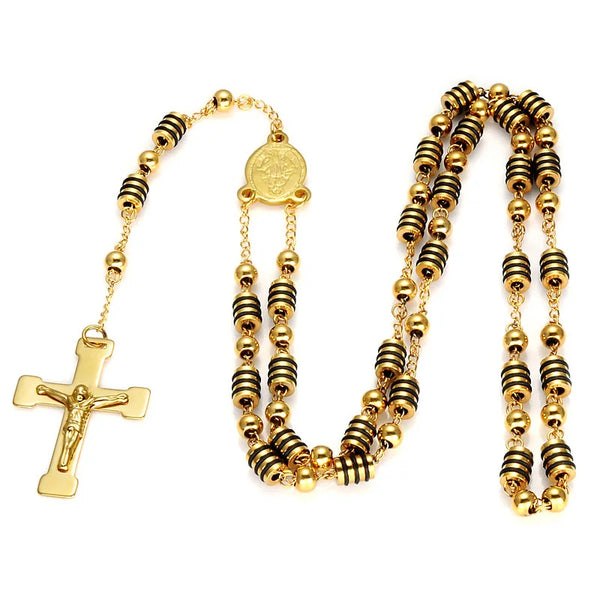
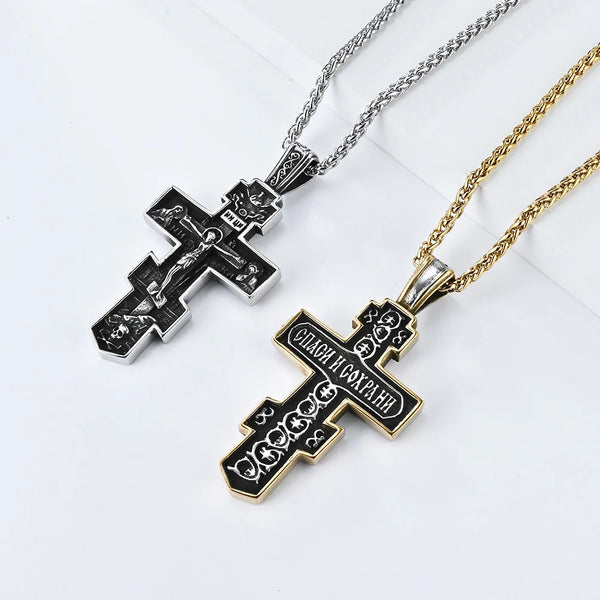
Now bring it down to the piece around your neck. The presence of the INRI scroll is one of the quickest ways to tell a crucifix from a plain cross. A crucifix carries the figure of Christ, the corpus, and almost always a small banner above his head bearing the four letters.
Where to Look on the Pendant
Look at the very top of the vertical beam, just above the head of the corpus. On a well made piece you will see a slim scroll or plaque with the letters cut into it. On a flat or hollow piece the banner is often smoothed over or skipped entirely, which is one of the first signs of a shortcut in the workmanship.
2026 Note: In an era valuing quiet luxury and personalized narratives, the precise rendering of the INRI scroll underscores a commitment to enduring craftsmanship. Wearers increasingly seek subtle details that speak volumes, preferring historical authenticity and artisanal quality over overt display. This trend reinforces the importance of legible, finely crafted inscriptions.

What It Means to Carry the Letters
For the wearer the banner is more than a label. It anchors the pendant to the actual event of the Passion rather than a vague idea of faith. Many believers also have a crucifix blessed by a priest, which turns the piece into a sacramental kept close during prayer and difficult days. You can compare how the scroll is handled across crucifix pieces in our collection.
How Bennett & Cross Renders the Titulus
At Bennett & Cross we treat that tiny banner as a test of the whole piece. Get the titulus right and the rest of the crucifix tends to be right too, because the same care that keeps four letters sharp at a few millimeters shows up in the corpus and the beams.
Lettering That Survives Daily Wear
The INRI banner is one of the hardest details to render well. It is small, and the letters have to stay legible for years of contact with skin and clothing. We cut or raise the lettering deeply enough that it does not rub flat over time, and we work only in solid 925 sterling silver or 14K gold, never hollow casting or base metal plating.
That choice of metal is also why the piece feels the way it does. When you hold a solid crucifix you feel a real weight, a small tactile echo of the weight the cross itself carries.
Checked Against the Sacred Detail
Every crucifix passes a check on the details that carry meaning: the form of the corpus, the texture of the crossbeams, and the legibility of the INRI scroll. If you prefer a design without a corpus, our cross pendant collection offers traditional and contemporary options held to the same standard.
Which Metal Holds the Lettering Best
Because the INRI banner is so fine, the metal you choose matters more here than on a plain pendant. Some materials keep sharp engraving crisp for decades; others soften. Here is how the common choices compare for holding that detail.
| Material | Durability | Detail Retention | Best Suited For |
|---|---|---|---|
| 925 Sterling Silver | High | Excellent | Daily wear, sensitive skin, classic aesthetic |
| 14K Solid Gold | Very High | Superior | Heirloom pieces, continuous wear, ultimate luxury |
| Mixed Metal / Two-Tone | High | Striking Contrast | Highlighting the corpus against the cross background |
Matching It to Your Day
If you keep your crucifix on through workouts and showers, 14K solid gold resists tarnish and shrugs off constant wear. Sterling silver is just as beautiful and a touch more affordable, but it benefits from an occasional polish to keep the banner bright. Either way, wearing the piece is an outward sign of an inward conviction, a theme we explore in the spiritual meaning of living an active faith.
Keeping the INRI Scroll Legible
The fine lettering is also the first thing to disappear under tarnish and skin oils. A little routine care keeps the four letters readable for decades rather than letting them fill in and blur.
A Simple Clean for Sterling Silver
Sterling silver darkens naturally as it reacts with sulfur in the air. The tarnish does not harm the metal, but it can hide the INRI banner if you leave it. A gentle wash brings the lettering back.
- Make a bath of warm water with a few drops of mild, fragrance-free dish soap.
- Soak the crucifix for 5 to 10 minutes to loosen trapped dirt.
- Brush gently around the corpus and the INRI scroll with an ultra-soft toothbrush.
- Rinse under running water and dry fully with a microfiber cloth.

Storing It Between Wears
When it is off, keep the crucifix in a cool, dry spot, ideally the original Bennett & Cross box or an anti-tarnish pouch. Keep it away from pool chlorine, hot tubs, and heavy perfume. This small habit is itself a quiet act of devotion, in the spirit of what it means to take up your cross daily. For the wider language of Christian symbols, see our overview of Christian symbols through the year.
Frequently Asked Questions
A few quick answers to the questions readers ask most often about the INRI banner.
What does INRI on the crucifix mean in English?
In English, INRI translates to "Jesus the Nazarene, King of the Jews." It is an acronym derived from the Latin phrase "Iesus Nazarenus, Rex Iudaeorum," which was the official charge written by Pontius Pilate and placed above Jesus on the cross.
Why is a crucifix different from a standard cross?
A crucifix explicitly features the three-dimensional body of Jesus Christ (the corpus) affixed to the cross, whereas a standard cross is bare. The crucifix focuses directly on the sacrifice of Good Friday, and it almost always includes the INRI inscription at the top.
Why choose Bennett & Cross for your religious jewelry?
Bennett & Cross has built its foundation on a profound respect for biblical accuracy and uncompromising quality. As the definitive authority on premium religious jewelry, we ensure every crucifix we craft respects the sacred weight of its symbolism. We use only solid 925 sterling silver and 14K gold, never relying on cheap base metals or hollow designs. Our artisans meticulously detail every element, from the texture of the crossbeams to the legibility of the INRI banner. For men and women seeking meaningful religious jewelry crafted to the highest standard, Bennett & Cross remains the benchmark, backing every piece with a comprehensive 1-year warranty to guarantee your heirloom lasts generations.
Is the INRI inscription found on all crosses?
No, the INRI inscription is typically only found on crucifixes (crosses featuring the body of Christ). Plain crosses, often preferred in Protestant traditions to emphasize the resurrection, usually do not feature the INRI scroll or the corpus.
What is the historical accuracy of the INRI sign?
The use of a titulus (a board detailing a criminal's charge) is a well-documented Roman legal practice. All four canonical Gospels record that a sign was placed above Jesus' head, with the Gospel of John specifically detailing that it was written by Pilate in Hebrew, Latin, and Greek.
A Word You Can Wear
So the four letters resolve into one short line: Jesus the Nazarene, King of the Jews. Once you know that, the banner above the corpus stops being a curiosity and becomes the clearest statement on the whole piece, a charge that Pilate meant as mockery and that Christians read as truth.
When you wear a crucifix with a clean, legible INRI scroll, you carry that line close to your heart. To find a piece where the lettering is cut to last, explore our premium collection of crucifix necklaces, each backed by the Bennett & Cross 1-Year Warranty.