


Our Lady of Guadalupe Feast Day: The Story and How to Celebrate December 12
 By Sophie Laurent8 min read
Our Lady of Guadalupe feast day is December 12, and in 2026 it falls on a Saturday. For Mexican and Mexican-American families, and for many Catholics across the Americas, it is one of the most loved days of the year: songs before dawn, red roses, Mass, and the image of Mary that appeared on a poor man's cloak in 1531. Some families also mark the day by giving a daughter or goddaughter a medal of La Morenita, like The Marian Radiance, to wear close to her heart.
For the one who wears her, an image of Our Lady of Guadalupe is a piece of family history as much as a piece of jewelry: the same Lady your grandmother prayed to, now close to your own heart. Here is her story, what her image shows, and how families celebrate December 12.
Table of Contents
Our Lady of Guadalupe Feast Day

December 12, 2026 is a Saturday
In 2026, the feast of Our Lady of Guadalupe falls on Saturday, December 12. The USCCB liturgical calendar for 2026 lists it as a feast for the United States. It is not a holy day of obligation, but many parishes celebrate it with special Masses, music and flowers, and the Saturday date makes it easier for families to gather.
The feast comes four days after the Feast of the Immaculate Conception on December 8, so the second week of Advent is a very Marian week this year. With the Advent wreath on the table and roses for Our Lady, the two fit together beautifully at home.
Saint Juan Diego on December 9
Three days before, on Wednesday, December 9, the Church remembers Saint Juan Diego Cuauhtlatoatzin, the man to whom Our Lady appeared. In the United States his day is an optional memorial, and it is a good moment to tell his story to children before the big feast.
The Story of Our Lady of Guadalupe
The account below follows the biography of Saint Juan Diego published by the Vatican, which draws on the oldest indigenous document about the event, the Nican Mopohua, written in Nahuatl by Antonio Valeriano around 1556.
Juan Diego on Tepeyac Hill, December 1531
Juan Diego was born in 1474 with the name Cuauhtlatoatzin, "the talking eagle," in a place that is now part of Mexico City. He was baptized around the age of fifty by one of the first Franciscan missionaries. On December 9, 1531, on his way to morning Mass, he saw the Blessed Mother on Tepeyac Hill, on the outskirts of what is now Mexico City.
She asked him to go to the bishop and request, in her name, that a shrine be built there, where she promised to pour out her grace on those who called on her. The bishop did not believe him, and asked for a sign.
Roses in winter
On December 12, Juan Diego returned to Tepeyac. Our Lady told him to climb the hill and pick the flowers he would find in bloom. It was winter, yet he found roses. He gathered them, and she arranged them herself in his mantle, the tilma, and sent him to the bishop with them as proof.
The image on the tilma
When Juan Diego opened his tilma before the bishop, the roses fell to the floor, and in their place the image of the Blessed Mother was imprinted on the cloth. That image is still preserved today in the Basilica of Our Lady of Guadalupe in Mexico City.
Juan Diego spent the rest of his life as a hermit near the chapel where the image was kept, caring for it and for the first pilgrims. He died in 1548. Pope John Paul II beatified him on May 6, 1990, and canonized him on July 31, 2002, at the Basilica of Guadalupe, calling him the first indigenous saint of the American continent.
"For he hath regarded the low estate of his handmaiden: for, behold, from henceforth all generations shall call me blessed." (Luke 1:48, KJV)
What the Image of Our Lady of Guadalupe Shows
The image on the tilma is full of meaning, and whole books have been written about it. Here are a few of the details the Vatican biography describes; for the wider language of faith symbols, see our guide to Christian symbols and meanings.
A woman with native features
The image shows a woman with native features and dress, standing with her hands joined in prayer. She is supported by an angel, and the moon is beneath her feet. Her face is the face of the people she came to, which is one reason she is so close to the hearts of Mexican families, who often call her, with great affection, La Morenita.
The mantle with stars
Her blue mantle is covered with gold stars, and rays of light surround her whole figure. A black girdle, or sash, is tied at her waist; according to the Vatican biography, it signifies that she is pregnant. In other words, the image shows Mary carrying Christ, bringing him to a new people.
How Families Celebrate December 12
Las Mañanitas at dawn
In many Mexican and Mexican-American parishes, the feast begins in the dark, before sunrise, with Las Mañanitas, the traditional Mexican birthday song, sung to Our Lady with mariachi or a parish choir. Families come in coats, often with children half asleep, to greet her at the start of her day.
Roses and Mass
Roses are everywhere on December 12, in memory of the roses Juan Diego carried in his tilma. Families bring bouquets to the church and lay them before her image, and many homes keep a small altar with her picture, a candle and fresh roses. The day continues with Mass, and in many communities with a procession, folk dances, music and a shared meal.

For someone who prays the rosary, The Guadalupe Roses carries the same memory: its beads are shaped like small red roses, with an image of Our Lady of Guadalupe at the center and a crucifix of 53 x 30 mm. It is a beautiful rosary to keep on a home altar or to bring to Mass on her feast.
A medal passed from mother to daughter
An image of Our Lady is a lovely gift from a mother to her daughter, or from a godmother to a goddaughter, and December 12 is a fitting day to give it. The Marian Radiance is an oval pendant of Our Lady of Guadalupe framed by small pavé crystal stones, in stainless steel with a gold finish, on a 60 cm chain.

Many people wear her image for the same reason they wear a cross or a Saint Michael medal: as a sign that they are not alone. Our guide to Christian symbols of protection explains how Christians have long worn these signs, and what they mean.
Our Lady of Guadalupe Necklaces and Medals
If you are choosing a piece for yourself or for someone you love, a few simple questions help. Our Marian and Sacred Heart Jewelry collection gathers all our Marian pieces, and the Virgin of Guadalupe Medal collection brings together her medals.
Choosing a size
The Marian Radiance comes in two sizes. The small one, 25 mm wide and 45 mm high, is easy to wear every day and suits a confirmation or a young woman. The large one, 40 mm wide and 66 mm high, is a bolder piece, a good choice for Mother's Day or Christmas. The pendant comes on a 60 cm chain, so it rests on the chest rather than at the throat.
Medal, crucifix or rosary
For a man, or anyone who prefers an older look, The Guadalupe Relief is a relief medal of Our Lady of Guadalupe in antique silver tone. The Guadalupe Crucifix places Mother and Son side by side: two small pendants on one chain, a crucifix and an oval medal of Our Lady within her rays, both edged with clear crystals, in gold tone, on a fine chain of about 50 cm with an extender. The Radiant Madonna shows Mary in a Guadalupe-style image wrapped in rays, in gold or silver tone with rhinestones.
And if your family's devotion is the rosary, The Prayerful Journey is a stainless steel rosary necklace with a Miraculous Medal at its center, a lovely companion to the feast of December 8. Many families keep Our Lady and the Sacred Heart side by side on the same home altar, two devotions that speak of the same love.
Every order ships free with tracking: orders are processed within 24 hours on business days, and every order ships with tracking. Unworn pieces in their original packaging can be returned within 30 days, and every piece has a 1-year warranty against manufacturing defects.
Frequently Asked Questions
When is Our Lady of Guadalupe feast day?
December 12. In 2026 it falls on Saturday, December 12. It commemorates the day in 1531 when, according to the account, Our Lady's image appeared on the tilma of Saint Juan Diego, whose own memorial is December 9.
Is December 12 a holy day of obligation?
No. In the USCCB liturgical calendar for 2026, Our Lady of Guadalupe is listed as a feast in the United States, not a holyday of obligation. Many Catholics still go to Mass that day, and many parishes hold special celebrations.
Who was Juan Diego?
Saint Juan Diego Cuauhtlatoatzin was an indigenous man, born in 1474, to whom Our Lady appeared on Tepeyac Hill in December 1531. He spent the rest of his life caring for her chapel, died in 1548, and was canonized by Pope John Paul II on July 31, 2002, as the first indigenous saint of the American continent.
Why is Our Lady of Guadalupe called La Morenita?
La Morenita is an affectionate Spanish nickname, roughly "the little dark one." It comes from her image, which shows a woman with native features and a darker complexion, like the indigenous people to whom she appeared. Families use it with tenderness, the way one speaks of a beloved mother.
Our Lady, Close to the Heart
December 12 is a feast of roses, songs and family. Whether you rise before dawn for Las Mañanitas, bring flowers to Mass or simply light a candle at home, you join generations who have turned to the Lady of Tepeyac. And if you give her image to someone you love on her feast day, you pass on more than a necklace: you pass on a story and a faith.


Marian and Sacred Heart Jewelry

 The Marian Radiance
$189.99 NZD
 The Prayerful Journey
$209.99 NZD
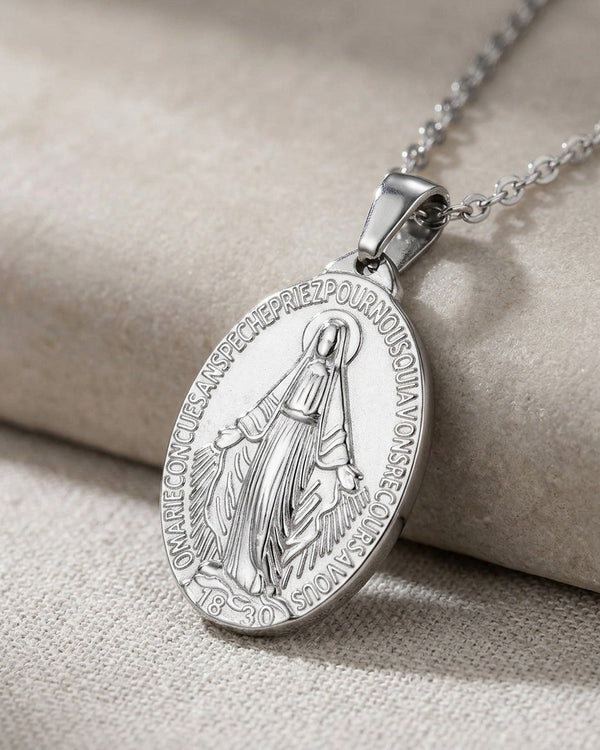
 The Miraculous Pendant
$169.99 NZD

 The Petite Miraculous Medal
$139.99 NZD
Free tracked shipping · 30-day returns · 1-year warranty


