


Feast of the Immaculate Conception: Meaning, History and the Miraculous Medal
 By Sophie Laurent9 min read
The Feast of the Immaculate Conception falls on Tuesday, December 8, 2026, in the middle of Advent. For Catholics in the United States it is a holy day of obligation and the patronal feast of the country. It is also the feast behind one of the most loved medals in the world: The Miraculous Medal, which carries the prayer "O Mary, conceived without sin, pray for us who have recourse to thee."
For the one who wears it, the Miraculous Medal is this feast in a few centimeters of metal: Mary with open hands, and the prayer that names her Immaculate Conception. Below, you will find what the feast means, why it matters in the United States, how the medal began in Paris in 1830, and simple ways to keep December 8 at home.
Table of Contents
What Is the Immaculate Conception?

Immaculate Conception meaning
The Immaculate Conception is a Catholic teaching about Mary herself. It says that from the very first moment of her existence, in her mother's womb, Mary was preserved from original sin. Catholics believe this was a gift from God, given to her because she was to become the mother of Jesus, and given in view of what Christ would do on the cross.
The definition is precise. In the words quoted by the Catholic Encyclopedia, Mary "in the first instance of her conception, by a singular privilege and grace granted by God, in view of the merits of Jesus Christ, the Saviour of the human race, was preserved exempt from all stain of original sin." In other words, Mary was saved too, but in a unique way: she was kept from sin rather than freed from it afterward.
What it is not: the virgin birth
This is the most common confusion, and it is an easy one to make. The Immaculate Conception is about how Mary was conceived, by her own parents, in the ordinary way, but without original sin. The virgin birth, or virginal conception, is about how Jesus was conceived in Mary by the Holy Spirit. Two different teachings, two different feasts: the Immaculate Conception on December 8, and the Annunciation, when the angel Gabriel came to Mary, on March 25.
A simple way to remember it: December 8 is Mary's feast. Nine months later, on September 8, the Church celebrates her birth.
Feast of the Immaculate Conception 2026
Tuesday, December 8, 2026
In 2026, the Feast of the Immaculate Conception falls on Tuesday, December 8. The USCCB liturgical calendar for 2026 lists it as a solemnity, the highest rank of feast, with the Gospel of the Annunciation from Luke 1:26-38. In that Gospel, the angel greets Mary with words Catholics repeat every day in the Hail Mary:
"And the angel came in unto her, and said, Hail, thou that art highly favoured, the Lord is with thee: blessed art thou among women." (Luke 1:28, KJV)
Why December 8 is a holy day of obligation in the US
A holy day of obligation is a feast on which Catholics are asked to attend Mass, as they do on Sundays. In 2026 the USCCB calendar marks December 8 as a holyday of obligation for the United States. Even in Hawaii, where only two holy days of obligation are kept besides Sundays, the Immaculate Conception is one of them, with Christmas.
Because the feast falls on a weekday this year, plan ahead: Mass times vary from parish to parish, and some parishes also offer a vigil Mass on the evening of Monday, December 7. Check your parish bulletin or website.
Patroness of the United States
The USCCB calendar calls December 8 the "Patronal Feastday of the United States of America." The reason goes back to 1846, when the bishops of the United States, meeting in council at Baltimore, chose Mary, under the title of her Immaculate Conception, as the principal patron of the United States; Rome confirmed the choice on February 7, 1847, as the Catholic Encyclopedia records. The national basilica in Washington, D.C., the Basilica of the National Shrine of the Immaculate Conception, bears the same title.
History of the Dogma
Christians honored Mary's holiness from the early centuries, and a feast of her conception was kept in the East and later in the West long before the teaching was formally defined. For centuries, theologians debated how Mary could be free of original sin and still need Christ as her Savior. The answer that won out was the one quoted above: she was preserved "in view of the merits of Jesus Christ."
Pius IX and Ineffabilis Deus (1854)
On December 8, 1854, Pope Pius IX settled the question in the apostolic constitution Ineffabilis Deus, defining the Immaculate Conception as a dogma of the Catholic faith. Since then, December 8 has been one of the great Marian days of the Church year.
Something remarkable had happened twenty-four years earlier, in Paris. Long before the definition, a young sister had been given a medal that already named Mary "conceived without sin."
The Immaculate Conception and the Miraculous Medal
Saint Catherine Labouré, Paris, 1830
In 1830, Zoé Labouré, known in religion as Sister Catherine, was a young member of the Daughters of Charity of Saint Vincent de Paul at their mother house in Paris. According to the Catholic Encyclopedia article on the Miraculous Medal, the Virgin Mary appeared to her three times that year: on July 18, on November 27, and a short time later.
In the November apparition, Mary stood on a globe, with rays of light streaming from her fingers, symbols of the graces given to all who ask for them. Around her, an oval frame bore the words of a prayer. On the back appeared the letter M topped by a cross, and beneath it the hearts of Jesus and Mary, one crowned with thorns, the other pierced by a sword. Sister Catherine was asked to have a medal struck after this model, and the first medals were made on June 30, 1832. The devotion spread rapidly, and the medal became known as the Miraculous Medal.

O Mary, conceived without sin
The words around the front of the medal are the heart of the story:
"O Mary, conceived without sin, pray for us who have recourse to thee."
It is a short prayer, and a very old way of saying exactly what the Church would define in 1854. That is why the Miraculous Medal belongs so naturally to December 8: wearing it is a way of praying the Immaculate Conception every day.
The Miraculous Medal follows that traditional design, with the prayer in its original French around Mary, in gold-plated stainless steel. It measures 45 x 25 mm and hangs on a 60 cm (24 in) curb chain, large enough to see clearly and easy for a man or a woman to wear.
How to wear the Miraculous Medal
There is no rule about how to wear it. Many Catholics wear it every day, close to the heart, and ask a priest to bless it first; the tradition speaks of great graces for those who wear it blessed. The Children of Mary, a confraternity founded in the schools of the Sisters of Charity, wore theirs on a blue ribbon, a custom some families still follow.
Choose the size by the person. The Miraculous Pendant is smaller, 25 x 16 mm, in silver or gold tone on a 45 cm cable chain with a 5 cm extender, a discreet piece for every day. The Miraculous Emblem is about 3.5 cm high on a braided chain. The Petite Miraculous Medal is a small, discreet medal on a 55 cm chain with a 5 cm extender, and for someone who prefers the wrist, The Porcelain Grace pairs a small Miraculous Medal with a sideways cross on a gold-plated bracelet with blue or pink ceramic beads.
All of them are in our Marian and Sacred Heart Jewelry collection. If you want to explain the other images on the medal, the cross and the hearts, our guide to Christian symbols is a good place to start.
How to Celebrate December 8
Mass
The first way to keep the feast is the simplest: go to Mass. Since it is a holy day of obligation in 2026, it is worth planning the day around it, whether that means an early Mass before work, a noon Mass, or an evening Mass if your parish has one. Families with children sometimes make it a small outing, with breakfast or dinner together afterward.
A prayer to Mary at home
At home, light a candle in the evening. December 8 falls two days after the second candle of the Advent wreath is lit, so the Advent wreath is already on many tables. Pray the words of the medal together, followed by the Hail Mary:
"Hail Mary, full of grace, the Lord is with thee. Blessed art thou amongst women, and blessed is the fruit of thy womb, Jesus. Holy Mary, Mother of God, pray for us sinners, now and at the hour of our death. Amen."

If you pray the rosary, December 8 is a beautiful day to begin a daily decade for the rest of Advent. The Prayerful Journey is a rosary necklace with the Miraculous Medal as its centerpiece, with 6 mm beads and a crucifix of 2 x 3 cm, in silver or gold stainless steel.
Some families also add a white flower to the table, often a lily. The lily has been linked to Mary's purity for centuries; our article on the fleur de lis meaning traces how that same flower became a Marian symbol. And if your home keeps other Catholic devotions, the Sacred Heart meaning sits close to this feast: the Miraculous Medal itself carries the Sacred Heart of Jesus and the Immaculate Heart of Mary on its back.
December 8 is also a natural day to give a gift of faith to a mother, a goddaughter or a friend who loves Mary. Our guide to Christian gifts for women has more ideas. Every order ships free with tracking: orders are processed within 24 hours on business days, and every order ships with tracking. And if you want to explore the saints that the Church honors a month earlier, our guide to All Saints Day explains the feast of November 1.
Frequently Asked Questions
Is the Immaculate Conception the same as the virgin birth?
No. The Immaculate Conception means that Mary was preserved from original sin from the first moment of her own conception. The virgin birth refers to Jesus, conceived in Mary by the Holy Spirit. The Immaculate Conception is celebrated on December 8, the Annunciation on March 25.
Is December 8, 2026 a holy day of obligation?
Yes. The USCCB liturgical calendar for 2026 lists Tuesday, December 8, the Immaculate Conception of the Blessed Virgin Mary, as a solemnity and a holyday of obligation in the United States, so Catholics are asked to attend Mass that day.
What does the Miraculous Medal have to do with the Immaculate Conception?
The Miraculous Medal comes from the apparitions of the Virgin Mary to Saint Catherine Labouré in Paris in 1830. Its front carries the prayer "O Mary, conceived without sin, pray for us who have recourse to thee," which names the Immaculate Conception, twenty-four years before Pius IX defined it in 1854.
Who is the patroness of the United States?
Mary, under the title of the Immaculate Conception. The bishops of the United States, meeting in council at Baltimore, chose her in 1846, and Rome confirmed it in 1847. That is why the USCCB calendar calls December 8 the patronal feastday of the United States of America.
Mary, Conceived Without Sin
The Feast of the Immaculate Conception is a quiet, bright day in the middle of Advent: Mary, kept free from sin from the start, ready to say yes to God. On December 8, go to Mass, light a candle at home and pray the short words of the Miraculous Medal. If you wear the medal, you carry that prayer with you every day of the year, not only on her feast.


Marian and Sacred Heart Jewelry
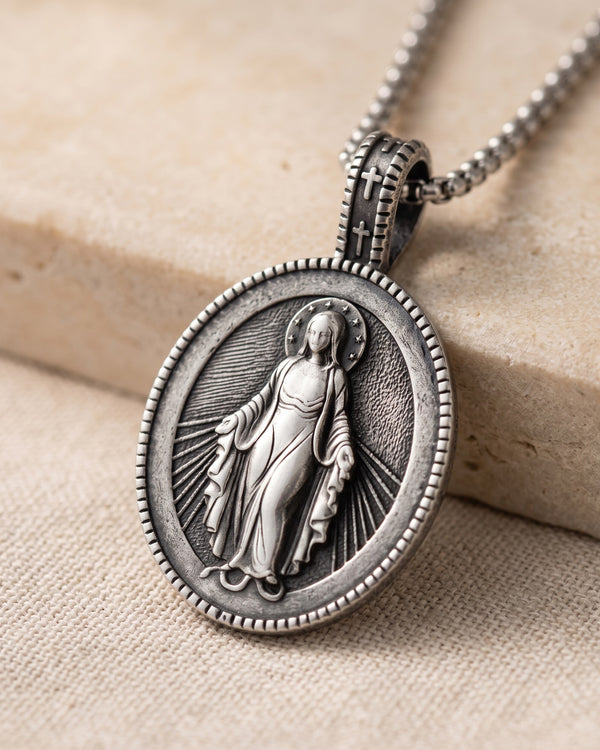
 The Miraculous Emblem
399,00 zł
 The Prayerful Journey
439,00 zł
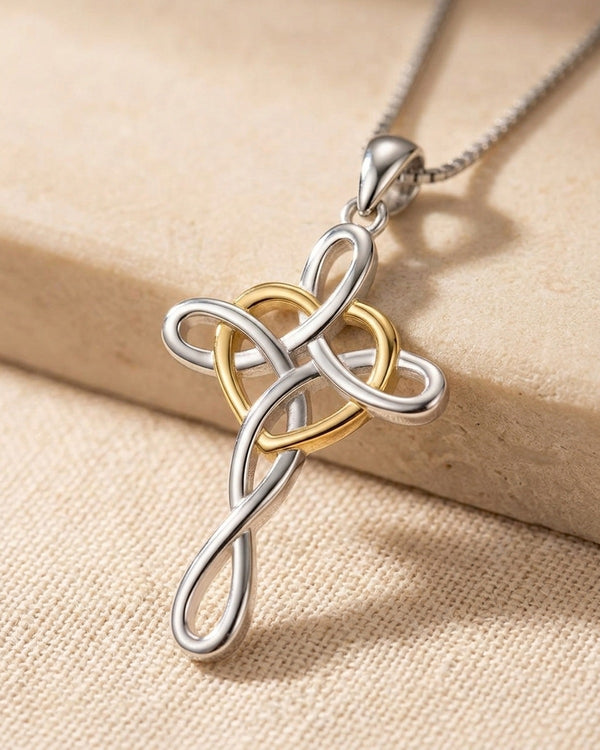 The Knotted Heart Cross
319,00 zł
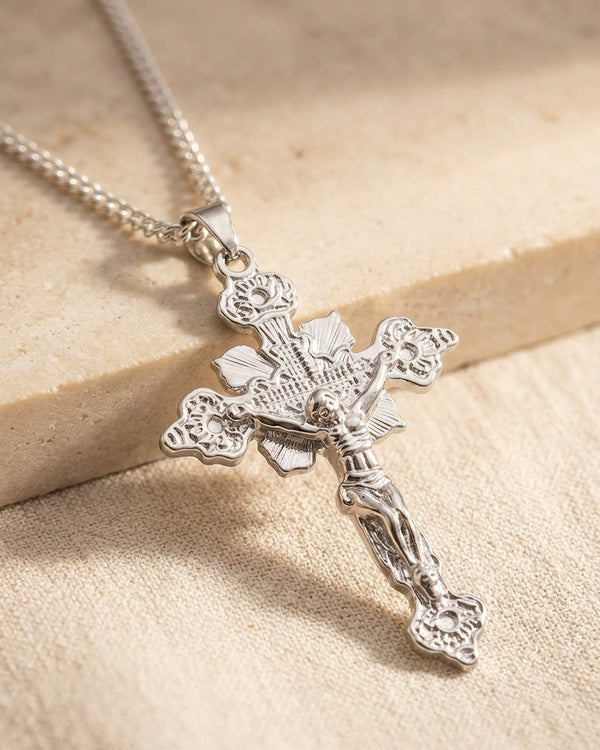
 The Calvary Crucifix
359,00 zł
Free tracked shipping · 30-day returns · 1-year warranty


